
BrandSensitize | Strategic Brand Evaluation & Marketing Advisory

Menu
Recent Posts
General Mills: Creating Brands That Feed the World
November 9, 2025

Danone: Renewing Health Through Food and Purposeful Growth
November 5, 2025

follow us
ASDA's 3-Year CEO Hunt: Inside Britain's Most Chaotic Retail Leadership Crisis
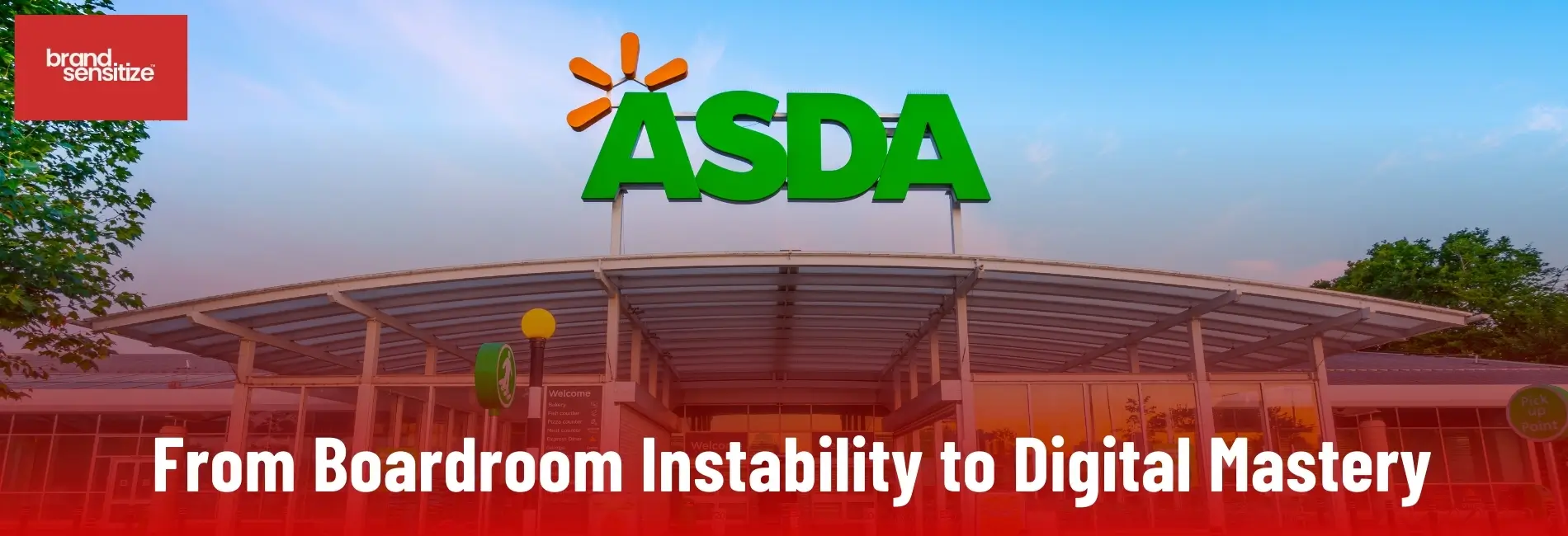
Beyond Price: ASDA’s Transformation from Value Leader to Customer Champion
ASDA is in the middle of one of the most ambitious transformations in UK retail. Known for decades as Britain’s value-focused supermarket, the company is now reshaping itself into more than just a price-conscious grocer. The goal is clear: deliver a shopping experience that’s affordable, innovative, and genuinely supportive of customers and communities.
At its heart, ASDA’s promise, Save Money. Live Better is no longer just about price. It’s about accessible quality, trusted value, and a deeper connection with households across the UK.
From Yorkshire Roots to Retail Giant
For more than 50 years, ASDA has been a familiar name in British homes. What started as a Yorkshire family business has grown into a retail powerhouse, with 1,200 large-format stores, a rapidly expanding Asda Express convenience network, food service outlets, and strong online platforms through Asda.com and George.com.
In FY24, ASDA reported total revenue of £26.8 billion (including fuel) and £21.7 billion in grocery alone. With around 150,000 employees and a 12.6% share of the UK grocery market, the company remains a central player in British retail.
The Leadership Void
Since CEO Roger Burnley’s departure in August 2021, ASDA has faced three and a half years without a permanent chief executive. This instability came at one of the most critical points in the company’s history. To steady the ship, Allan Leighton stepped in as executive chairman, tasked with restoring clarity and direction.
The Issa Brothers’ Era
Under Mohsin and Zuber Issa’s ownership, following their 2021 acquisition from Walmart, ASDA has been undergoing fundamental change. Strategic investments have strengthened pricing power, upgraded supply chain capabilities, and improved product availability (rising from 90% to 95%).
At the same time, the company has been separating from Walmart through Project Future, an IT and infrastructure overhaul that cost more than £1 billion, ran six months late, and caused serious supply chain and system challenges. Despite the turbulence, the separation has positioned ASDA for greater independence and growth.
Financial Snapshot
- FY24 Revenue (ex. fuel): £26.8bn
- Q1 2025 Revenue (ex. fuel): £5.0bn, down 5.9%
- George & Asda Express LFL sales: +3.5% and +6% respectively
- Net Debt: £3.8bn with over £0.8bn cash on hand
- Leverage: Reduced to 2.9x
Expanding Beyond Groceries
ASDA isn’t just about food anymore. Its portfolio spans George clothing, ASDA Mobile, ASDA Money, and ASDA Opticians, creating multiple touchpoints with customers beyond the weekly shop. This multi-brand strategy gives ASDA sustainable advantages, keeping it competitive in a crowded market.
A major focus is convenience and accessibility. The retailer plans to open 300 new ASDA Express stores in the coming years, while continuing to invest heavily in online grocery, click-and-collect, and delivery.
Customer Experience at the Core
ASDA’s customer strategy rests on two things: trusted value and seamless service.
- Knowledgeable colleagues who guide and support customers.
- ASDA Rewards loyalty program offering cashback and personalized deals.
- Digital tools across apps, websites, and stores to simplify shopping, manage deliveries, and improve inventory visibility.
The idea is simple: make shopping easy, whether it’s in a supercenter, an Express store, online delivery, or click-and-collect.
Technology & Innovation
Technology is at the center of ASDA’s reinvention. The company now operates under a dual IT leadership model:
- Marcus Shaw, CIO – responsible for infrastructure and operations.
- Adrian Berry, CTO – driving technology innovation.
Together with Matt Kelleher, Chief Digital Officer, they oversee digital operations, analytics, online growth, and LS11 Media. ASDA employs 800–1,200 permanent IT staff to support its network of 1,200+ stores and online platforms.
Post-Walmart, ASDA is forging new tech partnerships to modernize its systems. Cloud-first infrastructure, AI-powered personalization engines, and advanced pricing optimization tools are all part of the “New ASDA” strategy. The goal is to unify employees, suppliers, and customers under a more agile, data-driven retail ecosystem.
A Brand Philosophy Rooted in Families
At its core, ASDA’s mission hasn’t changed: help hardworking families save money and live better. What’s changing is how it delivers on that promise, by combining low prices with accessible quality, investment in local communities, and innovation that makes life easier.
For ASDA, the journey is no longer just about price leadership. It’s about becoming a customer champion, a retailer that’s affordable, relevant, and indispensable to British households.
BrandSensitize™ research shows that ASDA is heavily investing in cloud-first infrastructure and AI-powered personalization engines to support its pricing strategy and enhance operational efficiency across its growing store network.
Comments
Keith Nicks is EVP and Chief Digital & Commercial Officer for Ahold Delhaize USA, overseeing
omnichannel marketing, retail media, and e-commerce for U.S. brands. Tim Bork is the Chief Commercial
Officer for Ahold Delhaize Europe & Indonesia, focusing on local brands and responsible for growth,
including marketing and customer experience.
With nearly €96 billion in projected 2025 revenue, Ahold Delhaize ranks among the top 10 global
retailers, operating over 6,700 stores across multiple formats, including Albert Heijn, Delhaize, Food Lion,
Giant, Hannaford, and Stop & Shop.
6,700 stores powered by one procurement platform – a scale that makes others jealous.
For customers, Ahold isn’t just a grocery retailer; it’s a trusted lifestyle partner that combines the
intimacy of local shopping with the innovation and value of global retail leadership.
Ahold’s brands, such as Albert Heijn, Stop & Shop, and Giant, represent 37 years of average customer
relationships—customers don’t just shop there; they grow up with these brands, creating emotional
connections that transcend transactions.
After gaining thirty million loyalty members, Ahold demonstrated that personalization consistently
outperforms promotion.
BrandSensitize™ research shows that Ahold Delhaize operates with a decentralized marketing and brand
building approach, where marketing functions are embedded within:
- Brand-specific leadership (each local brand has its own marketing teams.
- Regional commercial officers who oversee marketing alongside broader commercial
responsibilities. - Digital and omnichannel specialists who handle modern marketing channels.
Ahold Delhaize’s Brand Building Initiatives:
Sustainability campaign: €50M investment reached 10M consumers, delivering a 20% boost in
sustainable product sales and generating €400M in revenue.
Digital Marketing: €150M digital budget achieved 25% higher engagement, 2.6% click-through rates (vs
1.9% industry standard), and built 500K+ social media following.
Loyalty Program: 30M members across brands with 85% customer penetration, driving 75% of total sales
and contributing €1B annually—10% better retention than competitors.
Strategic Brand Partnerships: 100+ collaborative campaigns with CPG brands, including Coca-Cola,
generated €600M in additional revenue through joint promotions.
Omnichannel Investment: A $1 billion price investment initiative, combined with AI-powered
personalization, aims to achieve an 80% loyalty sales penetration by 2028.
Strategic marketing drives measurable business results—from sustainability messaging to digital-first
loyalty programs, Ahold Delhaize demonstrates that well-executed brand-building campaigns deliver
both customer engagement and bottom-line growth on a global scale.
Ahold Delhaize’s Strategic Technology Partnerships:
- W23 Global VC Fund: $125M investment with Tesco, Woolworths & others backing AI startups
like Harmonya & Protex AI - Zycus Partnership: Source-to-Pay suite powering procurement across 6,700+ stores globally
- Hanshow Technology: Electronic shelf labels + innovation labs across all European locations.
- Inmar Intelligence: $141M in customer savings delivered through personalized digital coupons.
- DoorDash Collaboration: Tripled order volumes through enhanced last-mile delivery integration.
- Internal AI Innovation: MaxiGPT, LionGPT & Albot assistants deployed across the Serbian,
Belgian, and Czech markets. - New Tech Studio: AD/01 in Bucharest targeting 250+ tech talents for digital acceleration.
Zycus has licensed its comprehensive Source-to-Pay suite to Ahold Delhaize, including eSourcing,
Contract Lifecycle Management (CLM), and Supplier Management platforms.
TCS’s relationship with Ahold Delhaize marks a mature, strategic partnership focused on digital
transformation and supply chain technology.
Wipro partnered with Capgemini as one of the most significant retail transformation initiatives in the
world at Ahold USA.
Capgemini powers Ahold Delhaize’s end-to-end transformation, developing blockchain technology use
cases for Ahold Delhaize’s supply chain and leveraging its expertise in business transformation, as well as
its understanding of Ahold’s industry and operations.
Traditional retailers, equipped with AI and Robotics, will surpass pure digital players by 2030.
The key is to position Ahold not as just another retail success story, but as the company that has
rewritten the rules of digital transformation for every traditional business watching.
Leave a Reply