BrandSensitize | Strategic Brand Evaluation & Marketing Advisory

Menu
Recent Posts
follow us
Efficiency Meets Exclusivity: Why Costco’s Warehouse Empire Wins on Trust
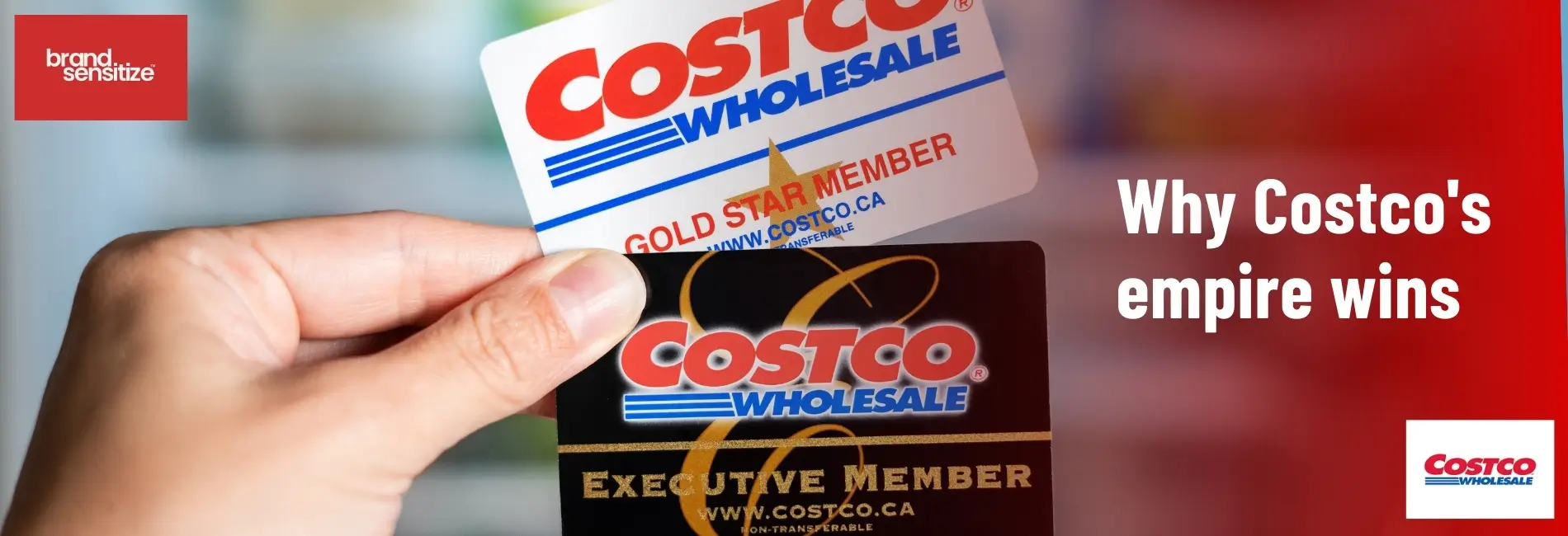
As a brand, Costco is a compelling example of quiet strength. It doesn’t shout or dazzle with ads, but it earns strong loyalty and moves huge volumes.
Costco reported total revenue of $268.78 billion for the trailing twelve months ending May 31, 2025, marking a 5.94% increase year over year. The company employs approximately 333,000 people worldwide, supporting its warehouse retail operations.
With over 130 million members globally and a 90%+ renewal rate, Costco has turned loyalty into a predictable revenue engine.
Costco’s brand philosophy is grounded in one straightforward promise: “continually provide our members with quality goods and services at the lowest possible prices.”
To deliver on that mission, the company follows a four-point Code of Ethics, obeying the law, taking care of members, taking care of employees, and respecting suppliers, which it views as the surest path to long-term shareholder value..
Key elements that put brand philosophy into practice
- Membership as a trust contract
- Efficiency over extravagance
- Quality without compromise
- Continuous operational improvement
Costco’s philosophy is focused on affordable prices, high quality, and ethical stewardship in a membership experience that rewards loyalty with tangible, reliable value.
Its brand isn’t transactional; members don’t just shop there, they advocate for it.
For decades, Costco has been a go-to marketplace for budget-conscious shoppers. From helping small and medium-sized businesses access high-quality goods in bulk at affordable prices to offering everyday essentials to individual shoppers. Costco’s warehouse-style stores are known as “Costco Wholesale.” There are over 800 Costco Wholesale locations worldwide.
Costco doesn’t adopt AI to impress; it adopts it to improve.
Its AI strategy centers on efficiency, simplicity, and trust, just like the brand itself. While others use AI to personalize ads or upsell aggressively, Costco leverages it to provide consistent value, optimize logistics, and enhance the member experience.
Costco’s brand promise is simple: High-quality goods at the lowest possible prices. But what sets it apart is that this value comes with trust. The curated product mix, limited SKUs, and member-only model create a sense of exclusivity wrapped in efficiency.
Costco doesn’t offer discounts to compete. It focuses on simplifying to outperform.
It was under the leadership of Costco’s co-founder and former CEO, Jim Sinegal, that the company introduced its single brand, named Kirkland Signature. Previously, Costco had almost 30 different brands for various products. However, after launching Kirkland Signature, everything was consolidated under one brand, making it easier for the company to deliver high-quality goods efficiently. Today, the brand is widely accepted by customers worldwide.
The food court makes Costco a destination, not just a store. Costco’s food court, particularly its fries and iconic menu items, plays a surprisingly significant role in its brand appeal, especially for families. The brand goes beyond its products available at the warehouse; it also manages Costco’s gas stations worldwide, which are exclusive to members.
No frills, no flashy marketing, and no aggressive sales tactics. Still, people enjoy the treasure hunt, discovering unexpected premium goods like Gold Coins, Rolex watches, Wagyu beef, wine, and tech gadgets at warehouse prices.
Costco redefines brand experience by focusing on utility, simplicity, and smart surprises.
Costco is the brand that built its empire by treating customers as partners, not targets. It’s not flashy, but it’s formidable. In a noisy market, Costco is the masterclass in brand restraint, operational integrity, and quiet excellence.
Comments
Keith Nicks is EVP and Chief Digital & Commercial Officer for Ahold Delhaize USA, overseeing
omnichannel marketing, retail media, and e-commerce for U.S. brands. Tim Bork is the Chief Commercial
Officer for Ahold Delhaize Europe & Indonesia, focusing on local brands and responsible for growth,
including marketing and customer experience.
With nearly €96 billion in projected 2025 revenue, Ahold Delhaize ranks among the top 10 global
retailers, operating over 6,700 stores across multiple formats, including Albert Heijn, Delhaize, Food Lion,
Giant, Hannaford, and Stop & Shop.
6,700 stores powered by one procurement platform – a scale that makes others jealous.
For customers, Ahold isn’t just a grocery retailer; it’s a trusted lifestyle partner that combines the
intimacy of local shopping with the innovation and value of global retail leadership.
Ahold’s brands, such as Albert Heijn, Stop & Shop, and Giant, represent 37 years of average customer
relationships—customers don’t just shop there; they grow up with these brands, creating emotional
connections that transcend transactions.
After gaining thirty million loyalty members, Ahold demonstrated that personalization consistently
outperforms promotion.
BrandSensitize™ research shows that Ahold Delhaize operates with a decentralized marketing and brand
building approach, where marketing functions are embedded within:
- Brand-specific leadership (each local brand has its own marketing teams.
- Regional commercial officers who oversee marketing alongside broader commercial
responsibilities. - Digital and omnichannel specialists who handle modern marketing channels.
Ahold Delhaize’s Brand Building Initiatives:
Sustainability campaign: €50M investment reached 10M consumers, delivering a 20% boost in
sustainable product sales and generating €400M in revenue.
Digital Marketing: €150M digital budget achieved 25% higher engagement, 2.6% click-through rates (vs
1.9% industry standard), and built 500K+ social media following.
Loyalty Program: 30M members across brands with 85% customer penetration, driving 75% of total sales
and contributing €1B annually—10% better retention than competitors.
Strategic Brand Partnerships: 100+ collaborative campaigns with CPG brands, including Coca-Cola,
generated €600M in additional revenue through joint promotions.
Omnichannel Investment: A $1 billion price investment initiative, combined with AI-powered
personalization, aims to achieve an 80% loyalty sales penetration by 2028.
Strategic marketing drives measurable business results—from sustainability messaging to digital-first
loyalty programs, Ahold Delhaize demonstrates that well-executed brand-building campaigns deliver
both customer engagement and bottom-line growth on a global scale.
Ahold Delhaize’s Strategic Technology Partnerships:
- W23 Global VC Fund: $125M investment with Tesco, Woolworths & others backing AI startups
like Harmonya & Protex AI - Zycus Partnership: Source-to-Pay suite powering procurement across 6,700+ stores globally
- Hanshow Technology: Electronic shelf labels + innovation labs across all European locations.
- Inmar Intelligence: $141M in customer savings delivered through personalized digital coupons.
- DoorDash Collaboration: Tripled order volumes through enhanced last-mile delivery integration.
- Internal AI Innovation: MaxiGPT, LionGPT & Albot assistants deployed across the Serbian,
Belgian, and Czech markets. - New Tech Studio: AD/01 in Bucharest targeting 250+ tech talents for digital acceleration.
Zycus has licensed its comprehensive Source-to-Pay suite to Ahold Delhaize, including eSourcing,
Contract Lifecycle Management (CLM), and Supplier Management platforms.
TCS’s relationship with Ahold Delhaize marks a mature, strategic partnership focused on digital
transformation and supply chain technology.
Wipro partnered with Capgemini as one of the most significant retail transformation initiatives in the
world at Ahold USA.
Capgemini powers Ahold Delhaize’s end-to-end transformation, developing blockchain technology use
cases for Ahold Delhaize’s supply chain and leveraging its expertise in business transformation, as well as
its understanding of Ahold’s industry and operations.
Traditional retailers, equipped with AI and Robotics, will surpass pure digital players by 2030.
The key is to position Ahold not as just another retail success story, but as the company that has
rewritten the rules of digital transformation for every traditional business watching.
Leave a Reply