
BrandSensitize | Strategic Brand Evaluation & Marketing Advisory

Menu
Recent Posts
follow us
Meijer's Modernization Initiative: Meeting Today’s Customer Expectations
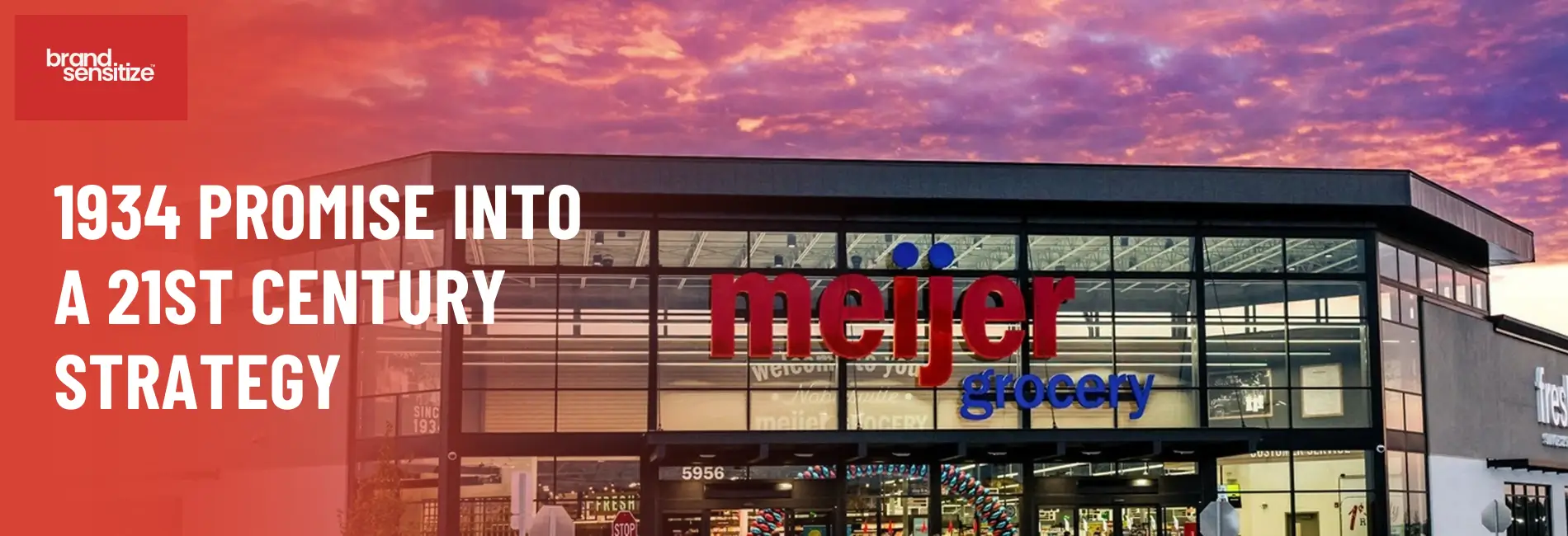
As a brand, Meijer exemplifies the evolution of American retail, rooted in family values but expanded for modern convenience. It doesn’t follow trends but fosters enduring community bonds through genuine Midwestern hospitality.
Meijer is a family-owned business, with the Meijer family holding the majority of the ownership. Meijer reported an annual revenue of $22.45 billion in 2024. The company employs over 70,000 people across the Midwest, supporting its supercenter and market format operations.
With over 273 stores and 208 fuel stations throughout Michigan, Ohio, Indiana, Illinois, Kentucky, and Wisconsin, Meijer has built community trust into sustainable growth for nearly a century. These locations include large supercenters, smaller grocery stores, neighborhood markets, and Meijer Express convenience stores.
Meijer’s brand philosophy focuses on a straightforward but impactful promise: “Higher quality, lower prices, and more of everything you need under one roof.” To fulfill this mission, the company operates on four core pillars: customers first, respect for people, honest business practices, and community stewardship, principles that have guided the family business since its founding in 1934.
Meijer’s philosophy turns everyday shopping into a community experience, offering not just products but a sense of belonging grounded in Midwest values. The brand promise is simple: quality products at great prices with unmatched convenience.
The supercenter format (introduced in 1962), along with local product sourcing and a community-focused approach, builds trust across generations. Meijer appeals to families seeking both convenience and quality. Beyond traditional retail, Meijer provides fuel stations, pharmacies, and specialty services that are exclusive to their customers.
Meijer Pharmacy is reaffirming its dedication to safeguarding Midwest communities through a strong selection of essential vaccines, offering not only the vaccines customers need but also guidance and support.
Customers enjoy the treasure hunt of finding everything from organic produce to home goods, electronics to pharmacy services, all under one roof at consistently competitive prices.
Meijer’s IT Maturity
Based on research and industry benchmarks, Meijer’s IT maturity can be rated as mid-level advancing, strong in foundational infrastructure but with room for improvement in digital innovation and scalability.
- Terry Ledbetter – SVP, CIO, responsible for overall IT strategy and operations.
- Kristen Williams – Group Vice President and CTO.
- Philip Keibler – Vice President, Chief Information Security Officer.
Meijer has made progress in:
- Store-wide Wi-Fi deployment
- AI-driven supply chain optimization
- Customer-facing digital tools like the mPerks app and self-checkout systems, offering personalized savings and curbside pickup.
These initiatives show proactive steps toward modernization. However, challenges remain:
- Legacy system integrations
- App glitches leading to inconsistent digital experiences
- Customer frustrations with online order accuracy and mobile app performance
This places Meijer’s IT maturity around Level 3 (Defined) on the CMMI scale, standardized but not fully optimized for agility.
Meijer’s Core Enterprise Technology Partners
- SAP – Enterprise Resource Planning
- Microsoft – Infrastructure & Productivity
- Oracle – Database & Retail application systems
- Salesforce – Customer Experience
- Adobe – Digital Marketing, CMS
- JDA Software (Blue Yonder) – Supply Chain
- Manhattan Associates – Order Management, Fulfillment
- NCR Corporation – POS Systems
- Verifone/Ingenico – Payment Processing
- IBM – Analytics & AI, Predictive analytics
- Google Cloud – Digital Infrastructure, Cloud storage
- Instacart & Shipt – Online Grocery Delivery
- Cisco Systems – Network Infrastructure
- VMware – Data Center Optimization
- NVIDIA – AI & Analytics
- AWS – Additional Cloud Services
- Reflexis Systems – Workforce Management
- Aptos Retail – Merchandising, Price Management
The Challenge
Despite this distributed technology landscape, Meijer is struggling with basic operational execution. Research shows:
- Customers feel “drained” by the shopping experience.
- Employees describe “palpable tension” and plummeting morale.
From a transformation perspective, Meijer should consider formally evaluating the Global Capability Center (GCC) model, a proven strategy for leading retailers. A well-organized GCC can:
- Enhance digital innovation
- Drive cloud migration
- Enable data-driven experiments
- Preserve Meijer’s brand identity and Midwest customer focus
The Question
How do you balance staying true to authentic brand values while complying with modern operational standards?
Is this a temporary growing pain for Meijer, or a warning about what occurs when family businesses neglect investing in customer experience infrastructure?
Comments
Keith Nicks is EVP and Chief Digital & Commercial Officer for Ahold Delhaize USA, overseeing
omnichannel marketing, retail media, and e-commerce for U.S. brands. Tim Bork is the Chief Commercial
Officer for Ahold Delhaize Europe & Indonesia, focusing on local brands and responsible for growth,
including marketing and customer experience.
With nearly €96 billion in projected 2025 revenue, Ahold Delhaize ranks among the top 10 global
retailers, operating over 6,700 stores across multiple formats, including Albert Heijn, Delhaize, Food Lion,
Giant, Hannaford, and Stop & Shop.
6,700 stores powered by one procurement platform – a scale that makes others jealous.
For customers, Ahold isn’t just a grocery retailer; it’s a trusted lifestyle partner that combines the
intimacy of local shopping with the innovation and value of global retail leadership.
Ahold’s brands, such as Albert Heijn, Stop & Shop, and Giant, represent 37 years of average customer
relationships—customers don’t just shop there; they grow up with these brands, creating emotional
connections that transcend transactions.
After gaining thirty million loyalty members, Ahold demonstrated that personalization consistently
outperforms promotion.
BrandSensitize™ research shows that Ahold Delhaize operates with a decentralized marketing and brand
building approach, where marketing functions are embedded within:
- Brand-specific leadership (each local brand has its own marketing teams.
- Regional commercial officers who oversee marketing alongside broader commercial
responsibilities. - Digital and omnichannel specialists who handle modern marketing channels.
Ahold Delhaize’s Brand Building Initiatives:
Sustainability campaign: €50M investment reached 10M consumers, delivering a 20% boost in
sustainable product sales and generating €400M in revenue.
Digital Marketing: €150M digital budget achieved 25% higher engagement, 2.6% click-through rates (vs
1.9% industry standard), and built 500K+ social media following.
Loyalty Program: 30M members across brands with 85% customer penetration, driving 75% of total sales
and contributing €1B annually—10% better retention than competitors.
Strategic Brand Partnerships: 100+ collaborative campaigns with CPG brands, including Coca-Cola,
generated €600M in additional revenue through joint promotions.
Omnichannel Investment: A $1 billion price investment initiative, combined with AI-powered
personalization, aims to achieve an 80% loyalty sales penetration by 2028.
Strategic marketing drives measurable business results—from sustainability messaging to digital-first
loyalty programs, Ahold Delhaize demonstrates that well-executed brand-building campaigns deliver
both customer engagement and bottom-line growth on a global scale.
Ahold Delhaize’s Strategic Technology Partnerships:
- W23 Global VC Fund: $125M investment with Tesco, Woolworths & others backing AI startups
like Harmonya & Protex AI - Zycus Partnership: Source-to-Pay suite powering procurement across 6,700+ stores globally
- Hanshow Technology: Electronic shelf labels + innovation labs across all European locations.
- Inmar Intelligence: $141M in customer savings delivered through personalized digital coupons.
- DoorDash Collaboration: Tripled order volumes through enhanced last-mile delivery integration.
- Internal AI Innovation: MaxiGPT, LionGPT & Albot assistants deployed across the Serbian,
Belgian, and Czech markets. - New Tech Studio: AD/01 in Bucharest targeting 250+ tech talents for digital acceleration.
Zycus has licensed its comprehensive Source-to-Pay suite to Ahold Delhaize, including eSourcing,
Contract Lifecycle Management (CLM), and Supplier Management platforms.
TCS’s relationship with Ahold Delhaize marks a mature, strategic partnership focused on digital
transformation and supply chain technology.
Wipro partnered with Capgemini as one of the most significant retail transformation initiatives in the
world at Ahold USA.
Capgemini powers Ahold Delhaize’s end-to-end transformation, developing blockchain technology use
cases for Ahold Delhaize’s supply chain and leveraging its expertise in business transformation, as well as
its understanding of Ahold’s industry and operations.
Traditional retailers, equipped with AI and Robotics, will surpass pure digital players by 2030.
The key is to position Ahold not as just another retail success story, but as the company that has
rewritten the rules of digital transformation for every traditional business watching.
Leave a Reply